Profit and Loss Aptitude: Complete Guide with Formulas, Tricks, Solved Examples & Practice Questions

If you’re preparing for campus placements or competitive exams, Profit and Loss is one topic you cannot afford to skip. It is one of the most frequently asked arithmetic topics in aptitude tests because it evaluates your numerical ability, logical thinking, and problem-solving skills.
Whether you’re appearing for TCS NQT, Infosys, Accenture, Wipro, Capgemini, Banking, SSC, CAT, MAT, or other competitive exams, you can expect at least one or two questions from this topic.
The good news is that Profit and Loss is one of the easiest topics to master. Once you understand the basic concepts and formulas, you’ll be able to solve most questions within a minute.
This guide explains every concept in a simple way with formulas, examples, shortcut tricks, practice questions, and FAQs.
What You’ll Learn
By the end of this guide, you’ll be able to:
- Understand Cost Price (CP), Selling Price (SP), Profit, and Loss
- Learn the most important Profit and Loss formulas
- Calculate Profit and Loss percentages accurately
- Understand why percentages are always calculated on Cost Price
- Relate Profit and Loss to real-life shopping and business situations
- Build a strong foundation for Discount, Marked Price, Simple Interest, and Compound Interest
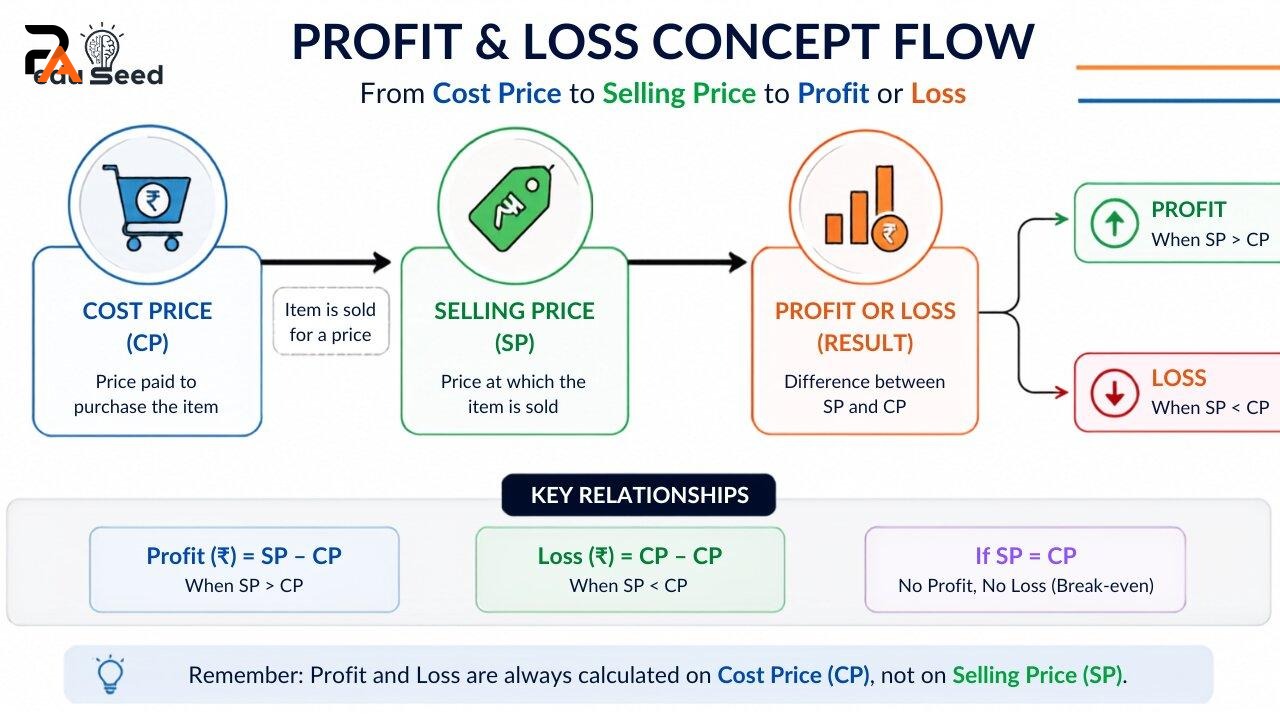
Why is Profit and Loss Important in Placement Exams?
Profit and Loss is not just an exam topic—it is a practical concept used in everyday life. Businesses use it to determine whether they are making a profit or facing a loss, while consumers use it to compare prices and evaluate discounts.
Recruiters include Profit and Loss questions because they assess:
- Numerical ability
- Percentage calculations
- Logical thinking
- Speed and accuracy
- Decision-making skills
💡Pocket Aptitude Tip: Since the formulas are simple, Profit and Loss is one of the quickest topics to score marks in aptitude exams.
What is Cost Price (CP)?
The Cost Price (CP) is the amount paid to purchase an item. It is also called the buying price because it represents the original cost of the product.
Examples
- Laptop bought for ₹45,000 → CP = ₹45,000
- Textbook bought for ₹600 → CP = ₹600
- Bicycle bought for ₹8,500 → CP = ₹8,500
No matter how much you sell the item later, its original purchase price remains the Cost Price.
What is Selling Price (SP)?
The Selling Price (SP) is the amount for which an item is sold to a customer.
| Selling Price | Result |
|---|---|
| SP > CP | Profit |
| SP = CP | No Profit, No Loss |
| SP < CP | Loss |
Examples
- Mobile bought for ₹20,000 and sold for ₹22,000 → SP = ₹22,000
- School bag bought for ₹1,500 and sold for ₹1,350 → SP = ₹1,350
What is Profit?
A Profit occurs when the Selling Price is greater than the Cost Price.
Formula
Profit = Selling Price − Cost PriceExample
Cost Price = ₹1,500
Selling Price = ₹1,800
Profit = 1,800 − 1,500 = ₹300What is Loss?
A Loss occurs when the Selling Price is less than the Cost Price.
Formula
Loss = Cost Price − Selling PriceExample
Cost Price = ₹800
Selling Price = ₹700
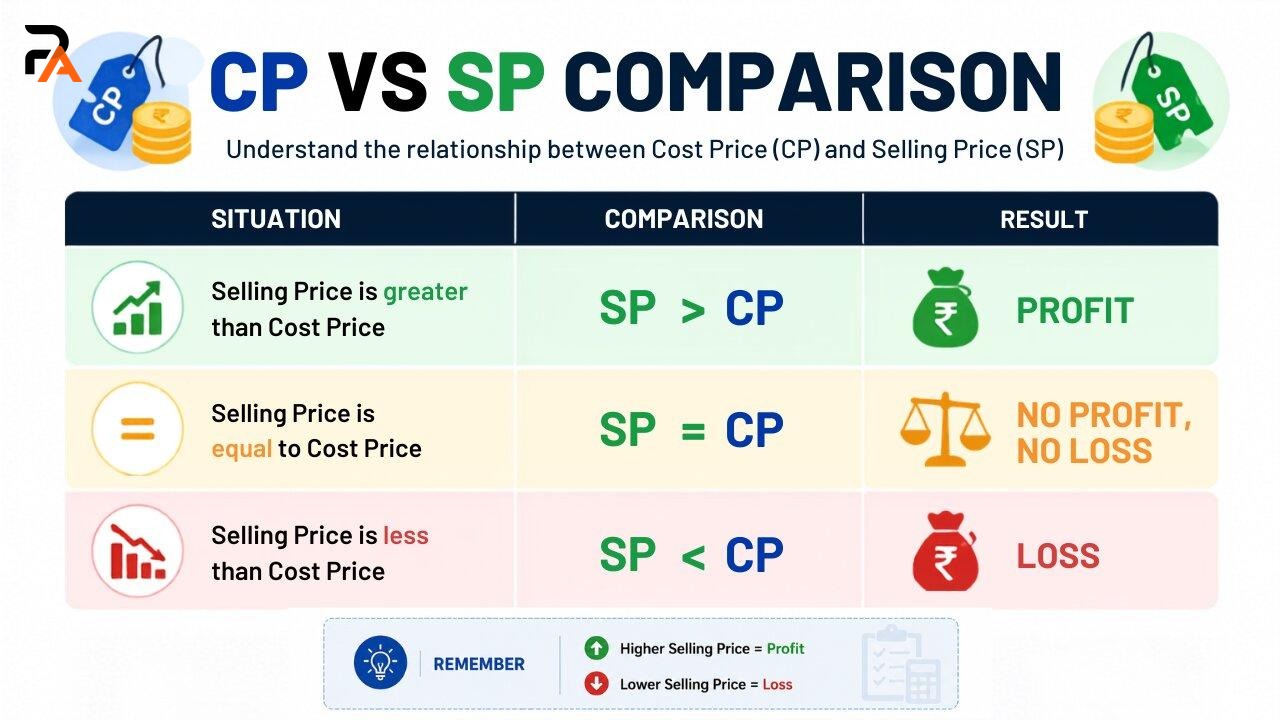
Loss = 800 − 700 = ₹100Relationship Between Cost Price and Selling Price
| Situation | Result |
|---|---|
| SP > CP | Profit |
| SP = CP | No Profit, No Loss |
| SP < CP | Loss |
Remember
- Higher Selling Price = Profit
- Lower Selling Price = Loss
Profit and Loss Formula Table
| Formula | Expression |
|---|---|
| Profit | SP − CP |
| Loss | CP − SP |
| Profit % | (Profit ÷ CP) × 100 |
| Loss % | (Loss ÷ CP) × 100 |
| Selling Price | CP + Profit |
| Selling Price | CP − Loss |
| Cost Price (Profit) | SP ÷ (1 + Profit%) |
| Cost Price (Loss) | SP ÷ (1 − Loss%) |
💡Pocket Aptitude Tip: Profit and Loss percentages are always calculated using the Cost Price (CP).
Understanding Profit Percentage
Formula
Profit % = (Profit ÷ Cost Price) × 100Example
CP = ₹600
SP = ₹750
Profit = ₹150
Profit % = (150 ÷ 600) × 100 = 25%Answer: 25% Profit
Understanding Loss Percentage
Formula
Loss % = (Loss ÷ Cost Price) × 100Example
CP = ₹2,000
SP = ₹1,700
Loss = ₹300
Loss % = (300 ÷ 2,000) × 100 = 15%Answer: 15% Loss
Why is Profit Percentage Always Calculated on Cost Price?
Many students mistakenly calculate Profit Percentage using the Selling Price.
This is incorrect because the Cost Price represents the original investment. Profit and Loss are always measured against the investment.
Example
CP = ₹10,000
SP = ₹12,000
Profit = ₹2,000
Profit % = (2,000 ÷ 10,000) × 100 = 20%Real-Life Applications of Profit and Loss
Shopping
A clothing store buys a T-shirt for ₹500 and sells it for ₹700.
Profit = ₹200
Online Selling
A student buys a used laptop for ₹25,000 and later sells it for ₹28,000.
Profit = ₹3,000
Grocery Store
A grocery shop purchases fruits for ₹5,000 but sells them for ₹4,500.
Loss = ₹500
Small Business
A bakery spends ₹2,000 on ingredients and sells cakes for ₹2,600.
Profit = ₹600

Profit and Loss Shortcut Tricks
Shortcut Trick 1: Use Multipliers
| Profit | Selling Price |
|---|---|
| 10% | CP × 1.10 |
| 20% | CP × 1.20 |
| 25% | CP × 1.25 |
| 50% | CP × 1.50 |
Example
CP = ₹800
25% Profit
SP = 800 × 1.25 = ₹1,000Shortcut Trick 2: For Loss Questions
| Loss | Selling Price |
|---|---|
| 10% | CP × 0.90 |
| 20% | CP × 0.80 |
| 25% | CP × 0.75 |
Example
CP = ₹2,000
20% Loss
SP = 2,000 × 0.80 = ₹1,600Shortcut Trick 3
Before solving any question, identify what needs to be found:
- Profit
- Loss
- Cost Price
- Selling Price
- Profit %
- Loss %
Choosing the correct formula first saves time.
Solved Examples
Example 1
A pen costs ₹120 and is sold for ₹150.
Profit = 150 − 120 = ₹30

Profit % = (30 ÷ 120) × 100 = 25%
Answer: 25% Profit
Example 2
A bicycle costs ₹6,000 and is sold at a 15% profit.
SP = 6,000 × 1.15 = ₹6,900Answer: ₹6,900
Example 3
A laptop is sold for ₹18,000 after earning a 20% profit.
CP = 18,000 ÷ 1.20 = ₹15,000Answer: ₹15,000
Example 4
A watch costs ₹2,500 and is sold for ₹2,125.
Loss = 2,500 − 2,125 = ₹375

Loss % = (375 ÷ 2,500) × 100 = 15%
Answer: 15% Loss
Common Mistakes Students Make
Avoid these mistakes:
- Calculating Profit Percentage using Selling Price
- Confusing Cost Price with Selling Price
- Using the Profit formula for Loss questions
- Forgetting to convert percentages correctly
💡Pocket Aptitude Tip: Read the question carefully before selecting the formula.
Practice Questions
-
A notebook costs ₹150 and is sold for ₹180. Find the Profit Percentage.
-
A chair costs ₹2,000 and is sold for ₹1,800. Find the Loss Percentage.
-
A bag costs ₹900 and is sold at a 20% profit. Find the Selling Price.
-
A laptop is sold for ₹24,000 after earning a 25% profit. Find the Cost Price.
-
A bicycle costs ₹8,500 and is sold for ₹9,350. Find the Profit.
Frequently Asked Questions (FAQs)
1. What is Profit and Loss in aptitude?
Profit and Loss is an arithmetic topic based on buying and selling goods. It is commonly asked in placement and competitive exams.
2. What is the formula for Profit Percentage?
Profit Percentage = (Profit ÷ Cost Price) × 1003. What is the formula for Loss Percentage?
Loss Percentage = (Loss ÷ Cost Price) × 1004. Why is Profit Percentage calculated on Cost Price?
Because Profit and Loss are measured against the original investment (Cost Price).
5. What is the difference between Cost Price and Selling Price?
- Cost Price (CP): Buying price
- Selling Price (SP): Price at which the item is sold
6. Which exams include Profit and Loss questions?
- Campus Placements
- TCS NQT
- Banking Exams
- SSC
- CAT
- MAT
- CMAT
- Government Recruitment Exams
7. How can I improve my speed?
- Memorize formulas
- Practice percentage calculations
- Use shortcut multipliers
- Solve aptitude questions daily
Related Articles
- Percentage Formula
- Discount
- Marked Price
- Simple Interest
- Compound Interest
- Ratio and Proportion
- Average
Conclusion
Profit and Loss is one of the easiest and highest-scoring topics in quantitative aptitude. Once you understand the relationship between Cost Price, Selling Price, Profit, and Loss, solving most questions becomes straightforward.
Rather than memorizing formulas alone, focus on understanding the concepts and practicing different types of questions. Regular practice will improve both your speed and accuracy, helping you perform confidently in campus placements and competitive exams.
Once you’ve mastered Profit and Loss, continue with Discount, as it builds directly on the same concepts and is another frequently asked aptitude topic.