Simple Interest Aptitude: Formulas, Tricks, Solved Examples & Practice Questions

Simple Interest is one of the easiest and most frequently asked topics in quantitative aptitude. Whether you’re preparing for TCS NQT, Infosys, Accenture, Wipro, SSC, Banking, CAT, Railways, or other competitive exams, understanding Simple Interest can help you score quick marks.
Most Simple Interest questions are formula-based and require only basic arithmetic. With a strong grasp of the formula and a few shortcut techniques, you can solve many questions in under a minute.
In this guide, you’ll learn:
- What Simple Interest is
- Important formulas
- Formula summary table
- Solved examples
- Shortcut tricks
- Common mistakes
- 30 practice questions
- FAQs
What is Simple Interest?
Simple Interest (SI) is the interest calculated only on the original principal amount. Unlike Compound Interest, the interest does not get added back to the principal after each period.
Example
If you invest ₹10,000 at 8% per annum for 3 years, the interest is calculated only on ₹10,000 every year.

Simple Interest at a Glance
| Term | Meaning |
|---|---|
| Principal (P) | Original amount borrowed or invested |
| Rate (R) | Annual interest rate (%) |
| Time (T) | Duration in years |
| Interest (SI) | Money earned or paid |
| Amount (A) | Principal + Interest |
Simple Interest Formula
Formula
SI = (P × R × T) / 100Where:
- P = Principal
- R = Rate of Interest (%)
- T = Time (Years)
Amount Formula
Amount = Principal + Simple Interestor
A = P + SI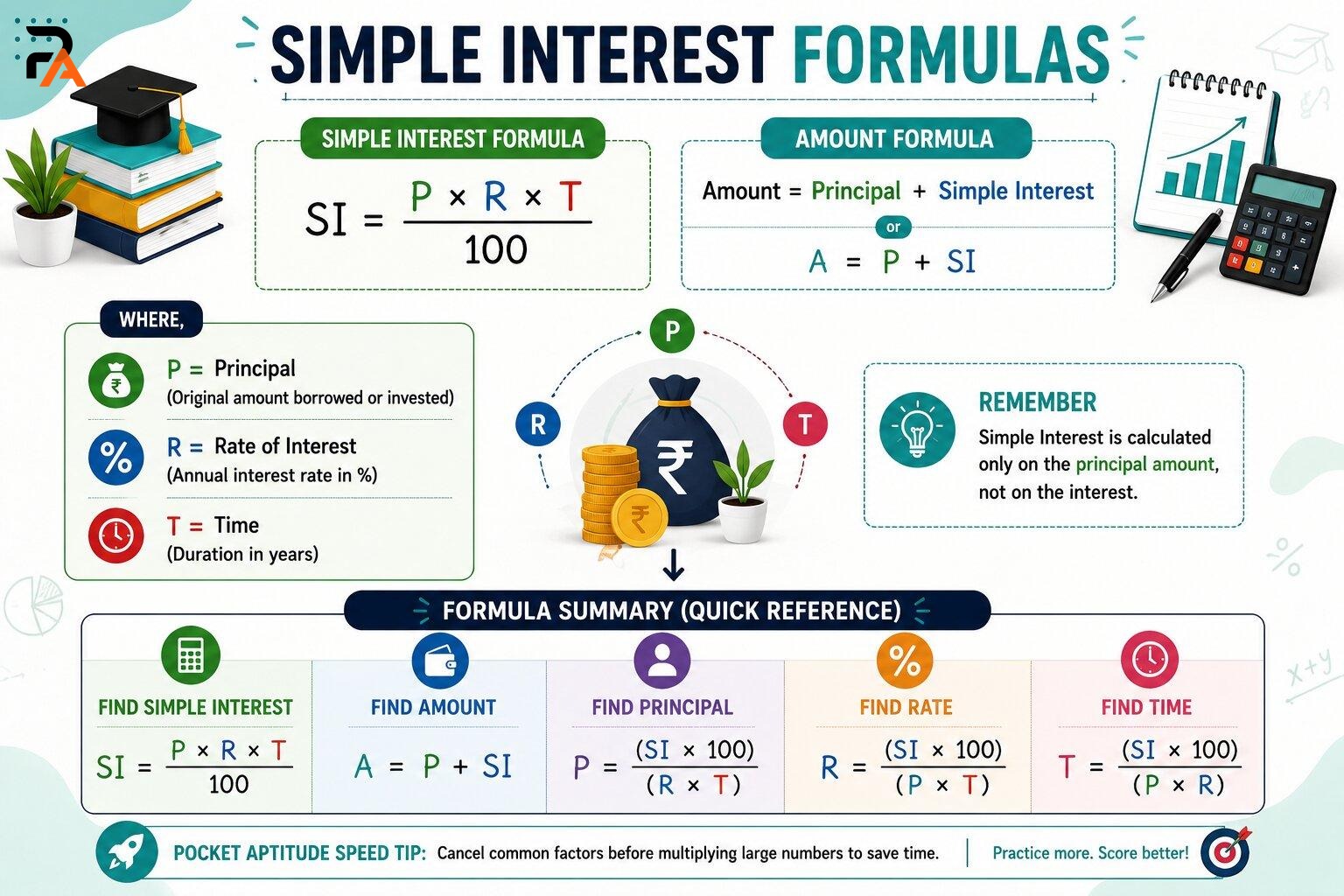
Formula Summary
| Find | Formula |
|---|---|
| Simple Interest | SI = (P × R × T) / 100 |
| Amount | A = P + SI |
| Principal | P = (SI × 100) / (R × T) |
| Rate | R = (SI × 100) / (P × T) |
| Time | T = (SI × 100) / (P × R) |
When to Use the Simple Interest Formula
Simple Interest is commonly used in:
- School aptitude questions
- Placement aptitude tests
- Banking exams
- Personal loans
- Short-term loans
- Some fixed deposits
- Financial literacy calculations
Solved Examples
Example 1 – Find Simple Interest
Question
A sum of ₹8,000 is invested at 10% per annum for 3 years.
Solution
SI = (8000 × 10 × 3) / 100
   = ₹2,400
Answer: ₹2,400
Example 2 – Find Amount
Question
- Principal = ₹12,000
- Rate = 5%
- Time = 4 years
Solution
SI = (12000 × 5 × 4) / 100
   = ₹2,400

Amount = 12,000 + 2,400
       = ₹14,400
Answer: ₹14,400
Example 3 – Find Principal
Question
- Interest = ₹900
- Rate = 6%
- Time = 3 years
Solution
P = (900 × 100) / (6 × 3)

P = ₹5,000
Example 4 – Find Rate
Question
- Principal = ₹10,000
- Interest = ₹2,500
- Time = 5 years
Solution
R = (2500 × 100) / (10000 × 5)

R = 5%
Example 5 – Find Time
Question
- Principal = ₹8,000
- Interest = ₹1,600
- Rate = 10%
Solution
T = (1600 × 100) / (8000 × 10)

T = 2 years
Example 6 – Time in Months
Question
- Principal = ₹12,000
- Rate = 12%
- Time = 18 months
Convert months into years.
18 months = 18 / 12 = 1.5 years

SI = (12000 × 12 × 1.5) / 100

SI = ₹2,160
Example 7 – Time in Days
Question
- Principal = ₹5,000
- Rate = 10%
- Time = 180 days
Convert days into years.
180 / 365 ≈ 0.493 years

SI ≈ ₹247
Example 8 – Word Problem
Ravi borrowed ₹15,000 at 8% simple interest for 2 years.
Interest = (15000 × 8 × 2) / 100
         = ₹2,400

Total Amount = ₹17,400
Example 9 – Placement Style Question
A sum becomes ₹11,500 after 3 years at 10% simple interest.
Find the principal.
Let Principal = P

Amount = P + 30% of P

Amount = 1.3P

1.3P = 11,500

P = ₹8,846.15
Example 10 – Mixed Aptitude Question
A sum doubles in 20 years under simple interest.
Find the annual rate.
Interest = Principal

R = 100 / 20

R = 5%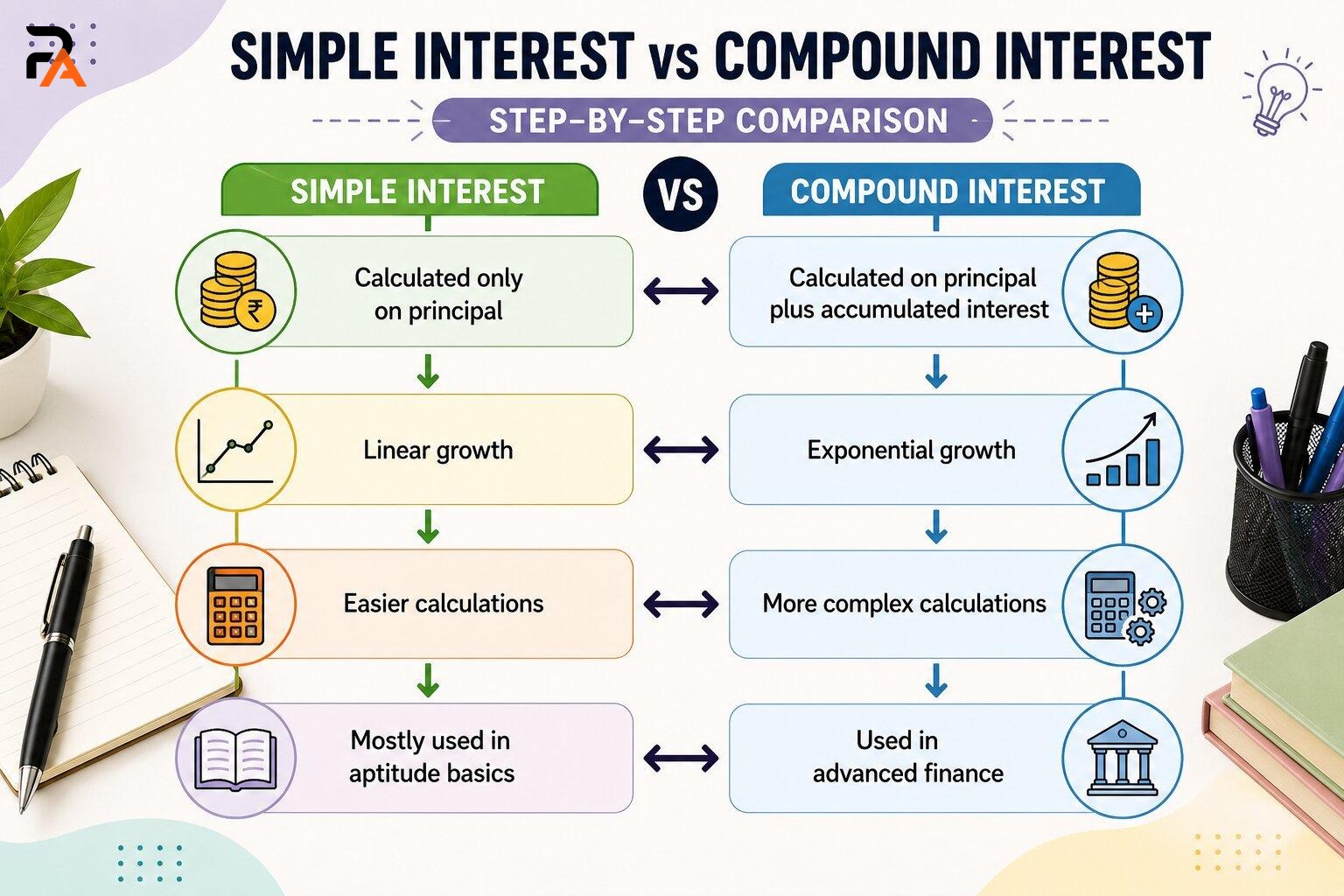
Simple Interest vs Compound Interest
| Simple Interest | Compound Interest |
|---|---|
| Calculated only on principal | Calculated on principal plus accumulated interest |
| Linear growth | Exponential growth |
| Easier calculations | More complex calculations |
| Mostly used in aptitude basics | Used in advanced finance |
Coming Soon: Compound Interest Aptitude Guide
Pocket Aptitude Speed Tips
Tip 1
Cancel common factors before multiplying.
Example:
(5000 × 12 × 5) / 100

5000 ÷ 100 = 50

50 × 12 × 5
This saves time during exams.
Tip 2
Memorize common percentages.
- 5%
- 10%
- 20%
- 25%
- 50%
These frequently appear in aptitude questions.
Tip 3
Always convert months into years before applying the formula.
Tip 4
Write the formula first.
This reduces calculation mistakes.
Common Exam Traps
Many students lose easy marks because of small mistakes.
Avoid these:
- Forgetting to convert months into years
- Confusing Amount with Interest
- Ignoring the phrase per annum
- Dividing incorrectly by 100
- Using the Compound Interest formula instead of Simple Interest
- Writing the wrong unit for time
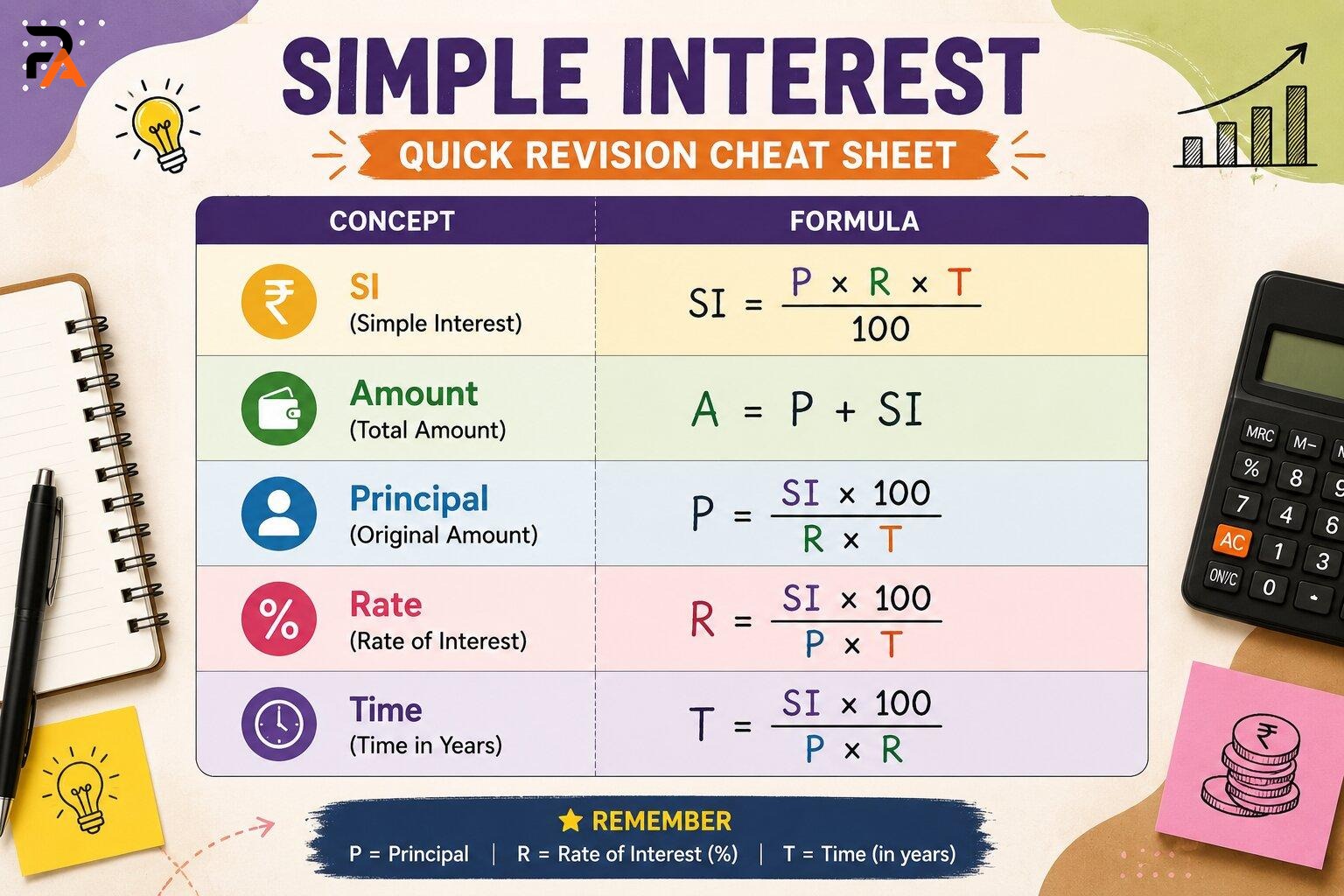
Quick Revision Table
| Concept | Formula |
|---|---|
| SI | (P × R × T) / 100 |
| Amount | P + SI |
| Principal | (SI × 100) / (R × T) |
| Rate | (SI × 100) / (P × T) |
| Time | (SI × 100) / (P × R) |
Practice Questions
Beginner (1–10)
Intermediate (11–20)
Placement Level (21–30)
Answers
Frequently Asked Questions
1. What is Simple Interest?
Simple Interest is interest calculated only on the original principal amount.
2. What is the formula for Simple Interest?
SI = (P × R × T) ÷ 1003. What is the difference between Simple Interest and Compound Interest?
Simple Interest is calculated only on the principal, while Compound Interest is calculated on the principal plus previously earned interest.
4. Can time be given in months?
Yes. Convert months into years by dividing by 12.
5. Can time be given in days?
Yes. Convert days into years, usually by dividing by 365 (or 366 in a leap year if specified).
6. Is the interest rate always annual?
In aptitude questions, the rate is usually given per annum (per year) unless stated otherwise.
7. Which exams ask Simple Interest questions?
TCS NQT, Infosys, Accenture, Wipro, SSC, Banking, Railways, CAT, MAT, CMAT, and many state-level competitive exams.
8. Can the interest rate change every year?
The standard Simple Interest formula assumes a constant rate. If the rate changes each year, calculate the interest separately for each period and add the results.
9. How can I solve Simple Interest questions faster?
Memorize the formulas, simplify calculations by cancelling common factors before multiplying, and always convert the time into years before applying the formula.
10. Is Amount the same as Interest?
No.
- Interest is the extra money earned or paid.
- Amount is the total of the principal and the interest.
Summary
Simple Interest is one of the highest-scoring topics in quantitative aptitude because the concepts are straightforward and formula-based. By understanding the core formulas, practicing different question types, avoiding common mistakes, and using shortcut techniques, you can solve most Simple Interest problems quickly and accurately.
If you’ve already learned Percentage, Profit & Loss, and Discount, Simple Interest becomes even easier because it builds directly on percentage calculations. Continue practicing regularly, and then move on to Compound Interest to strengthen your aptitude skills further.