Number Series Aptitude: Complete Guide with Tricks, Solved Examples & Practice Questions

Number Series is a simple and highly scoring topic in Quantitative Aptitude. It tests your logical thinking, observation, and pattern-recognition skills rather than lengthy calculations.
The key is to identify the pattern connecting the numbers. Common patterns include addition, subtraction, multiplication, division, squares, cubes, prime numbers, Fibonacci sequences, and mixed operations. With regular practice, many number series questions can be solved in less than a minute.
By the end of this article, you’ll be able to:
- Understand how number series questions are framed.
- Identify common mathematical patterns.
- Solve questions faster using logical observation.
- Avoid common mistakes made during exams.
- Build confidence for competitive aptitude tests.
Quick Answer
A Number Series is a sequence of numbers arranged according to a specific mathematical or logical rule. Your objective is to identify that rule and determine the next number, the missing number, or the incorrect number in the sequence.
For example:
2, 4, 6, 8, 10, ?
Pattern:
+2
Answer:
12
Another example:
5, 10, 20, 40, 80, ?
Pattern:
×2
Answer:
160
Although some sequences are straightforward, others may involve alternating operations, perfect squares, prime numbers, cubes, or multiple mathematical rules. The more patterns you practice, the easier it becomes to recognize them during an exam.
What is Number Series?
A Number Series is an ordered sequence of numbers where every term follows a particular mathematical relationship with the previous term or terms. Your task is to identify this relationship and use it to predict the next value or determine the missing number.
Think of a number series as a puzzle. Every number provides a clue, and once you discover the rule connecting them, solving the puzzle becomes straightforward.
Consider the following example:
12, 15, 18, 21, 24, ?
Each number increases by 3.
Therefore,
24 + 3 = 27
Now consider another sequence.
3, 6, 12, 24, 48, ?
Each number is multiplied by 2.
Therefore,
48 × 2 = 96
Some sequences are slightly more challenging.
1, 4, 9, 16, 25, ?
These numbers represent:
- 1²
- 2²
- 3²
- 4²
- 5²
The next number is:
6² = 36
Not every number series follows a single mathematical operation. Many competitive exams intentionally combine two or more operations to test your analytical thinking. For example:
5, 8, 16, 19, 38, 41, ?
Here, the pattern alternates between:
+3, ×2, +3, ×2…
Recognizing such patterns requires careful observation.
Number series questions generally ask you to:
- Find the next number.
- Find the missing number.
- Identify the wrong number.
- Complete the sequence.
- Choose the correct option from multiple answers.
Although these questions may look different, the underlying principle remains the same—identify the hidden mathematical pattern.

Why is Number Series Important?
Number series is considered one of the highest-scoring aptitude topics because it combines speed with logical reasoning. Unlike topics that require lengthy calculations or multiple formulas, number series mainly depends on recognizing patterns.
Since most competitive exams have strict time limits, solving these questions quickly allows you to save valuable time for more calculation-intensive sections.
Learning number series also improves several important skills beyond aptitude exams.
Benefits of Learning Number Series
- Improves logical reasoning.
- Enhances observation skills.
- Strengthens mental mathematics.
- Increases calculation speed.
- Builds analytical thinking.
- Improves confidence in quantitative aptitude.
- Helps solve questions with greater accuracy.
- Saves time during competitive examinations.
These skills are useful not only for entrance exams but also for interviews, coding assessments, logical reasoning tests, and everyday problem-solving.
Where Are Number Series Questions Asked?
Number series is a common topic in various competitive examinations, including:
| Examination | Number Series Questions |
|---|---|
| SSC CGL | Frequently Asked |
| SSC CHSL | Frequently Asked |
| Banking (IBPS, SBI, RBI) | Frequently Asked |
| Railway Recruitment | Frequently Asked |
| Insurance Exams | Frequently Asked |
| CAT & MBA Entrance | Occasionally Asked |
| Campus Placements | Frequently Asked |
| Defence Exams | Frequently Asked |
| State Government Exams | Frequently Asked |
Because the topic appears across so many examinations, mastering it provides an advantage regardless of the career path you choose.

Skills Required to Solve Number Series
Many students assume that solving number series requires advanced mathematics. In reality, the most important skill is observation.
A good aptitude solver looks for hidden relationships instead of immediately performing random calculations.
Some essential skills include:
- Identifying differences between consecutive numbers.
- Recognizing multiplication and division patterns.
- Observing alternating sequences.
- Understanding perfect squares and cubes.
- Remembering common prime numbers.
- Applying logical reasoning.
As you practice more questions, your brain automatically begins recognizing these patterns, allowing you to solve problems much faster.
Tips Before You Start Solving Number Series
Before attempting any question, follow these simple steps:
- Check whether the numbers are increasing or decreasing.
- Find the difference between consecutive numbers.
- If the differences are irregular, check multiplication or division.
- Look for square or cube numbers.
- Check whether alternate numbers follow separate patterns.
- Observe if more than one operation is being used.
- Avoid guessing before identifying the pattern.
Following this systematic approach will help you solve most number series questions with confidence and accuracy.
Types of Number Series
Not all number series follow the same pattern. Some involve simple addition, while others require multiplication, division, squares, cubes, prime numbers, or even a combination of multiple mathematical operations. The first step in solving any number series question is identifying which type of pattern is being used.
Competitive exams generally ask questions from a limited set of commonly repeated patterns. Once you become familiar with these patterns, solving number series questions becomes much easier and faster.
1. Arithmetic & Geometric Number Series
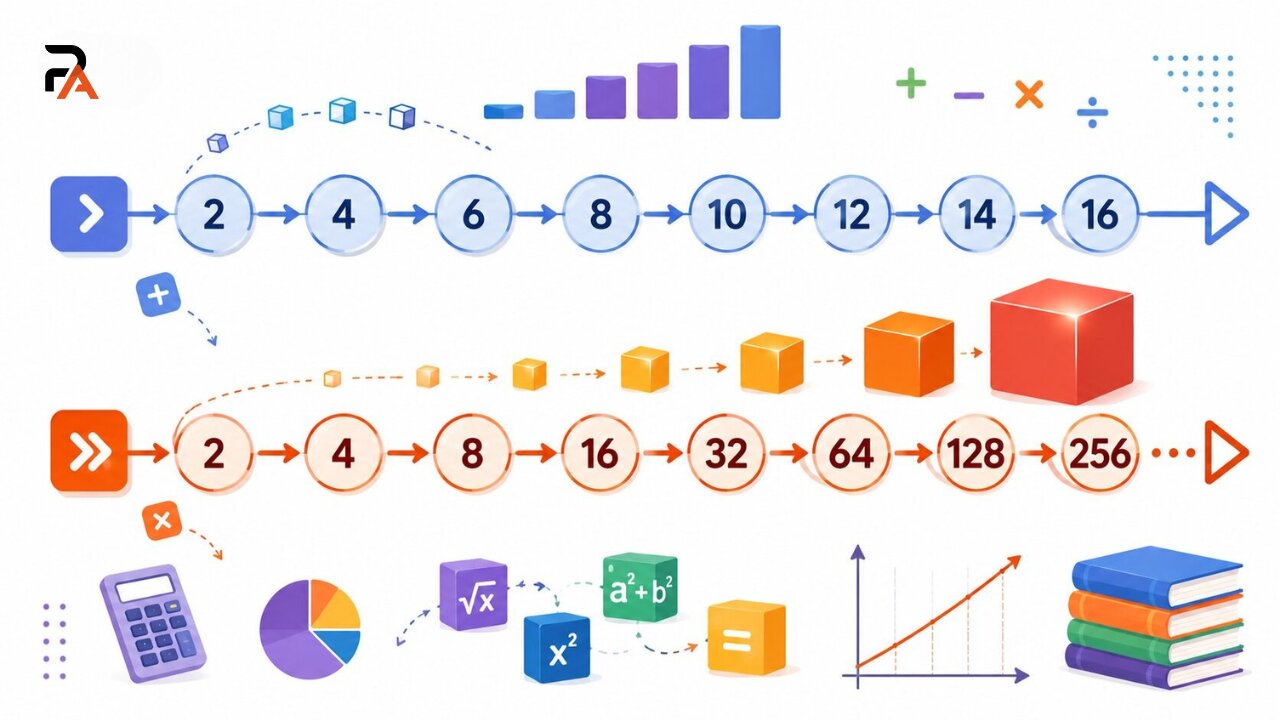
An Arithmetic Number Series has a constant difference between consecutive terms. A Geometric Number Series has a constant ratio between them instead.
Arithmetic: Next Number = Previous Number + d Geometric: Next Number = Previous Number × r
Example (Arithmetic): 8, 12, 16, 20, 24, ? — the difference is +4, so the answer is 28.
Example (Geometric): 3, 6, 12, 24, 48, ? — the ratio is ×2, so the answer is 96.
2. Square & Cube Number Series
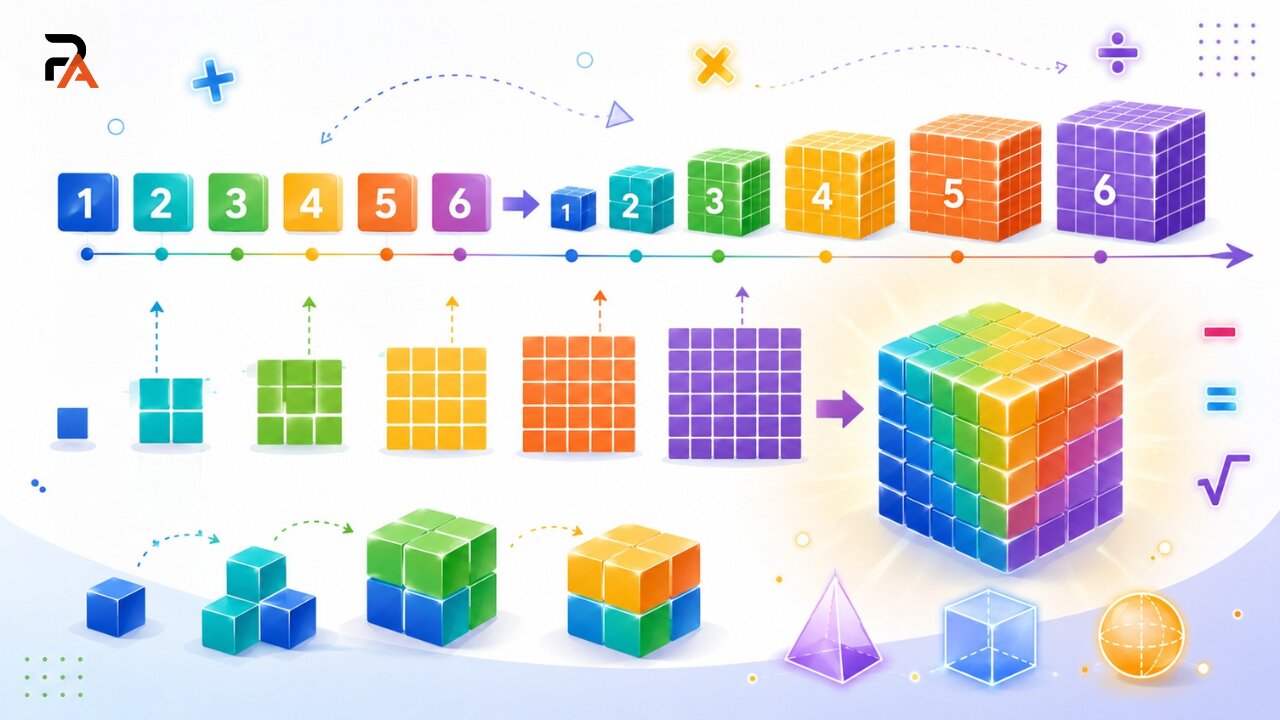
A Square Number Series is built from perfect squares (n²), and a Cube Number Series is built from perfect cubes (n³). Whenever you spot numbers like 25, 36, 49, 64, 81, 125, or 216, think squares and cubes first.
Example (Square): 1, 4, 9, 16, 25, 36, ? — these are 1² to 6², so the next term is 7² = 49.
Example (Cube): 1, 8, 27, 64, 125, ? — these are 1³ to 5³, so the next term is 6³ = 216.
3. Prime Number Series
Terms follow the sequence of prime numbers — numbers with exactly two factors, 1 and themselves. Memorizing the first 30 primes (2, 3, 5, 7, 11, 13, 17, 19, 23, 29…) saves valuable time.
Example: 2, 3, 5, 7, 11, 13, 17, ? — the next prime after 17 is 19.
4. Fibonacci Number Series
Each term is the sum of the previous two terms — one of the most famous patterns in math.
Next Number = Previous Number + Second Previous Number
Example: 1, 1, 2, 3, 5, 8, 13, ? — 13 + 8 = 21.
5. Alternating Number Series

Two independent patterns run at once — odd-position terms follow one rule, even-position terms follow another. Split the sequence into odd and even positions before solving.
Example: 2, 5, 4, 10, 6, 20, 8, ? — odd positions (2, 4, 6, 8) go +2, even positions (5, 10, 20) go ×2, so the answer is 40.
6. Mixed Operation Series
Two or more operations combine and repeat, such as ×2 +1. These are common in higher-level exams — try a combination once a single operation fails to fit.
Example: 3, 7, 15, 31, 63, ? — each term is ×2 +1 of the previous one, so the answer is 63 × 2 + 1 = 127.
Quick Recap
| Type | Common Pattern |
|---|---|
| Arithmetic | +a or −a |
| Geometric | ×a or ÷a |
| Square | n² |
| Cube | n³ |
| Prime | Prime Numbers |
| Fibonacci | Sum of previous two terms |
| Alternating | Two separate patterns |
| Mixed Operation | Combination of multiple operations |
Understanding these eight patterns forms the foundation of solving almost every number series question asked in competitive examinations. Before attempting shortcuts or advanced techniques, ensure you are comfortable identifying each of these series. Once you can recognize the pattern quickly, solving even complex questions becomes much more manageable.

How to Solve Number Series Questions
Understanding the different types of number series is only the first step. The real challenge is identifying the hidden pattern quickly during an examination. Since competitive exams are time-bound, spending too much time on a single question can affect your overall score.
Instead of randomly trying different mathematical operations, follow a systematic approach. Most number series questions can be solved by checking a few common patterns in the correct order.
Step 1: Observe the Numbers Carefully
Before performing any calculations, take a few seconds to look at the sequence as a whole.
Ask yourself questions such as:
- Are the numbers increasing or decreasing?
- Is the increase gradual or rapid?
- Are there very large jumps between numbers?
- Do the numbers appear familiar?
For example:
10, 20, 30, 40, 50, ?
The numbers increase steadily.
Without performing any calculations, you can already guess that this is likely an arithmetic series.
Step 2: Check the Difference
The first thing you should calculate is the difference between consecutive numbers.
Example
7, 12, 17, 22, 27, ?
Difference:
12 − 7 = 5
17 − 12 = 5
22 − 17 = 5
27 − 22 = 5
Since the difference remains constant, the next number is:
27 + 5 = 32
If the differences are equal, you’ve found an arithmetic sequence.
Step 3: Check the Ratio
If the differences are not equal, check whether the numbers are being multiplied or divided.
Example
4, 8, 16, 32, 64, ?
Each number is multiplied by 2.
64 × 2 = 128
Example
162, 54, 18, 6, 2, ?
Each number is divided by 3.
Answer:
2 ÷ 3 = 2/3
Step 4: Look for Square and Cube Numbers
Many aptitude questions are based on perfect squares and cubes.
Memorizing these values saves valuable time.
Common Squares
| Number | Square |
|---|---|
| 1 | 1 |
| 2 | 4 |
| 3 | 9 |
| 4 | 16 |
| 5 | 25 |
| 6 | 36 |
| 7 | 49 |
| 8 | 64 |
| 9 | 81 |
| 10 | 100 |
Common Cubes
| Number | Cube |
|---|---|
| 1 | 1 |
| 2 | 8 |
| 3 | 27 |
| 4 | 64 |
| 5 | 125 |
| 6 | 216 |
| 7 | 343 |
| 8 | 512 |
Whenever you notice numbers like 49, 64, 81, 125, 216, immediately consider square or cube patterns.
Step 5: Check Prime Numbers
Prime numbers are another favourite pattern in aptitude exams.
The first few prime numbers are:
2, 3, 5, 7, 11, 13, 17, 19, 23, 29, 31
Example:
5, 7, 11, 13, 17, ?
Answer:
19
Learning the first 30 prime numbers can significantly improve your solving speed.
Step 6: Separate Odd and Even Positions
Sometimes a sequence looks confusing because it actually contains two independent patterns.
Example
2, 8, 4, 16, 6, 32, 8, ?
Odd-position numbers:
2, 4, 6, 8
Pattern:
+2
Even-position numbers:
8, 16, 32
Pattern:
×2
Answer:
64
Whenever a single pattern doesn’t fit, divide the sequence into odd and even positions.
Step 7: Look for Mixed Operations
Higher-level aptitude exams often combine multiple operations.
Example
5, 11, 23, 47, 95, ?
Pattern:
×2 +1
5 ×2 +1 = 11
11 ×2 +1 = 23
23 ×2 +1 = 47
47 ×2 +1 = 95
Answer:
95 ×2 +1 = 191
These questions become easy once you identify the repeating operation.
Step 8: Check the Difference of Differences
Sometimes the first difference is irregular.
In such cases, calculate the second difference.
Example
2, 5, 10, 17, 26, ?
First Difference:
3, 5, 7, 9
Second Difference:
2, 2, 2
The next first difference becomes:
11
Therefore,
26 + 11 = 37
This technique is extremely useful for advanced aptitude questions.
Number Series Shortcuts & Tricks
Competitive exams reward speed as much as accuracy. Learning a few shortcuts can help you identify patterns almost instantly.
1Always Start with the Difference
Nearly half of all number series questions are addition or subtraction in disguise. Check the difference before reaching for multiplication.
2Memorize Common Squares
Recognize 1, 4, 9, 16, 25, 36, 49, 64, 81, 100, 121, 144, 169, 196, 225 on sight — no need to calculate them mid-exam.
3Memorize Common Cubes
Cube numbers jump fast. Knowing 1³ to 20³ turns intimidating big numbers into instant recognition.
4Learn Prime Numbers
Exams rarely go past the first 30 primes. Memorize them once, solve prime-based series in seconds for the rest of your prep.
5Don't Ignore Alternate Numbers
If one pattern doesn't fit every number, split the sequence into odd and even positions before assuming it's unsolvable.
6Look for Increasing Differences
When the differences aren't equal, check whether the differences themselves increase by a constant step — common in SSC and Banking exams.
7Check Multiplication Followed by Addition
Mixed operations like ×2 +1 are extremely common in placement aptitude tests — check for them before assuming the series has no pattern.
8Eliminate Impossible Options
In MCQ-based exams, scan the options first. Often only one fits the expected pattern — saving you a full solve under time pressure.
Common Mistakes to Avoid
Even well-prepared candidates lose marks because of small mistakes.
Here are the most common ones:
Looking at Only One Pattern
Students often assume the first operation they notice is correct.
Always verify the pattern with every number in the sequence.
Ignoring Alternate Positions
Many alternating series appear random until the odd and even terms are separated.
Forgetting Squares and Cubes
Not recognizing numbers like 64, 81, 125, or 216 can lead to unnecessary calculations.
Guessing Too Early
Avoid selecting an answer before checking the complete pattern.
One incorrect assumption can change the entire sequence.
Spending Too Much Time
If a pattern doesn’t appear within a minute, mark the question for review and continue with the next one. Time management is just as important as solving correctly.
Solved Number Series Examples
The best way to master number series is through regular practice. While learning the patterns is important, solving a variety of questions helps you recognize those patterns quickly during competitive exams.
The following solved examples are arranged from easy to moderate difficulty. Read each solution carefully to understand the logic behind the answer.
4, 8, 12, 16, 20, ?
Solution3, 6, 12, 24, 48, ?
Solution1, 4, 9, 16, 25, ?
Solution8, 27, 64, 125, ?
Solution2, 3, 5, 7, 11, 13, ?
Solution1, 1, 2, 3, 5, 8, 13, ?
Solution5, 10, 20, 40, 80, ?
Solution50, 45, 40, 35, 30, ?
Solution2, 5, 10, 17, 26, ?
Solution2, 5, 4, 10, 6, 20, 8, ?
Solution7, 14, 28, 56, 112, ?
Solution100, 90, 80, 70, 60, ?
Solution5, 11, 23, 47, 95, ?
Solution6, 12, 24, 48, 96, ?
Solution81, 27, 9, 3, 1, ?
SolutionPractice Questions
Before you calculate, take a guess. Pick an option for each question below to reveal the full solution — your score tallies up as you go.
2, 4, 6, 8, 10, ?
🤔 Without calculating, what do you think?
👇 Pick an option to see the answer
5, 10, 20, 40, 80, ?
🤔 Without calculating, what do you think?
👇 Pick an option to see the answer
1, 4, 9, 16, 25, ?
🤔 Without calculating, what do you think?
👇 Pick an option to see the answer
8, 27, 64, 125, ?
🤔 Without calculating, what do you think?
👇 Pick an option to see the answer
2, 3, 5, 7, 11, ?
🤔 Without calculating, what do you think?
👇 Pick an option to see the answer
1, 1, 2, 3, 5, 8, ?
🤔 Without calculating, what do you think?
👇 Pick an option to see the answer
100, 90, 80, 70, 60, ?
🤔 Without calculating, what do you think?
👇 Pick an option to see the answer
3, 6, 12, 24, 48, ?
🤔 Without calculating, what do you think?
👇 Pick an option to see the answer
2, 5, 10, 17, 26, ?
🤔 Without calculating, what do you think?
👇 Pick an option to see the answer
2, 5, 4, 10, 6, 20, 8, ?
🤔 Without calculating, what do you think?
👇 Pick an option to see the answer
11, 22, 44, 88, ?
🤔 Without calculating, what do you think?
👇 Pick an option to see the answer
9, 18, 36, 72, ?
🤔 Without calculating, what do you think?
👇 Pick an option to see the answer
121, 144, 169, 196, ?
🤔 Without calculating, what do you think?
👇 Pick an option to see the answer
216, 343, 512, 729, ?
🤔 Without calculating, what do you think?
👇 Pick an option to see the answer
13, 17, 19, 23, 29, ?
🤔 Without calculating, what do you think?
👇 Pick an option to see the answer
Frequently Asked Questions (FAQs)
1. What is a Number Series in aptitude?
A Number Series is a sequence of numbers that follows a logical or mathematical pattern. Your task is to identify the pattern and find the next, missing, or incorrect number.
2. Which competitive exams include Number Series questions?
Number Series questions commonly appear in SSC, Banking (IBPS, SBI), Railway, Insurance, Defence, State Government exams, CAT, MBA entrance tests, and campus placement assessments.
3. How can I solve Number Series questions faster?
Practice regularly, memorize common square numbers, cube numbers, and prime numbers, and always check differences, ratios, and alternating patterns before trying complex operations.
4. Is Number Series difficult?
No. Once you understand the common patterns and practice enough questions, Number Series becomes one of the easiest and fastest-scoring aptitude topics.
5. What are the most common Number Series patterns?
The most frequently asked patterns include arithmetic, geometric, square numbers, cube numbers, prime numbers, Fibonacci series, alternating series, and mixed-operation series.
6. How many Number Series questions are asked in competitive exams?
The number varies by exam, but most aptitude tests include 2–5 Number Series questions in the quantitative aptitude section.
7. Should I memorize squares, cubes, and prime numbers?
Yes. Memorizing squares up to 30², cubes up to 20³, and the first 30 prime numbers can significantly improve your speed and accuracy.
8. How often should I practice Number Series?
Practicing 10–20 questions daily is enough to build confidence and improve pattern recognition over time.
Summary
Number Series is one of the most important and rewarding topics in quantitative aptitude. By understanding the common patterns, following a step-by-step solving approach, and practicing regularly, you can answer these questions quickly and accurately in competitive exams.
Instead of memorizing solutions, focus on identifying the logic behind each sequence. As you gain experience, you’ll recognize familiar patterns instantly, helping you save time and improve your overall exam performance.
Consistency is the key to success. Make Number Series a regular part of your aptitude preparation, and you’ll soon find it becoming one of your strongest topics.
Related Articles
- Simplification and Approximation
- Percentage Aptitude Questions
- Ratio and Proportion
- Average Aptitude Guide
- Time, Speed and Distance
- Profit and Loss
- Logical Reasoning for Beginners
- Quantitative Aptitude Shortcut Tricks