Average Aptitude Questions: Formula, Tricks, Examples & Practice

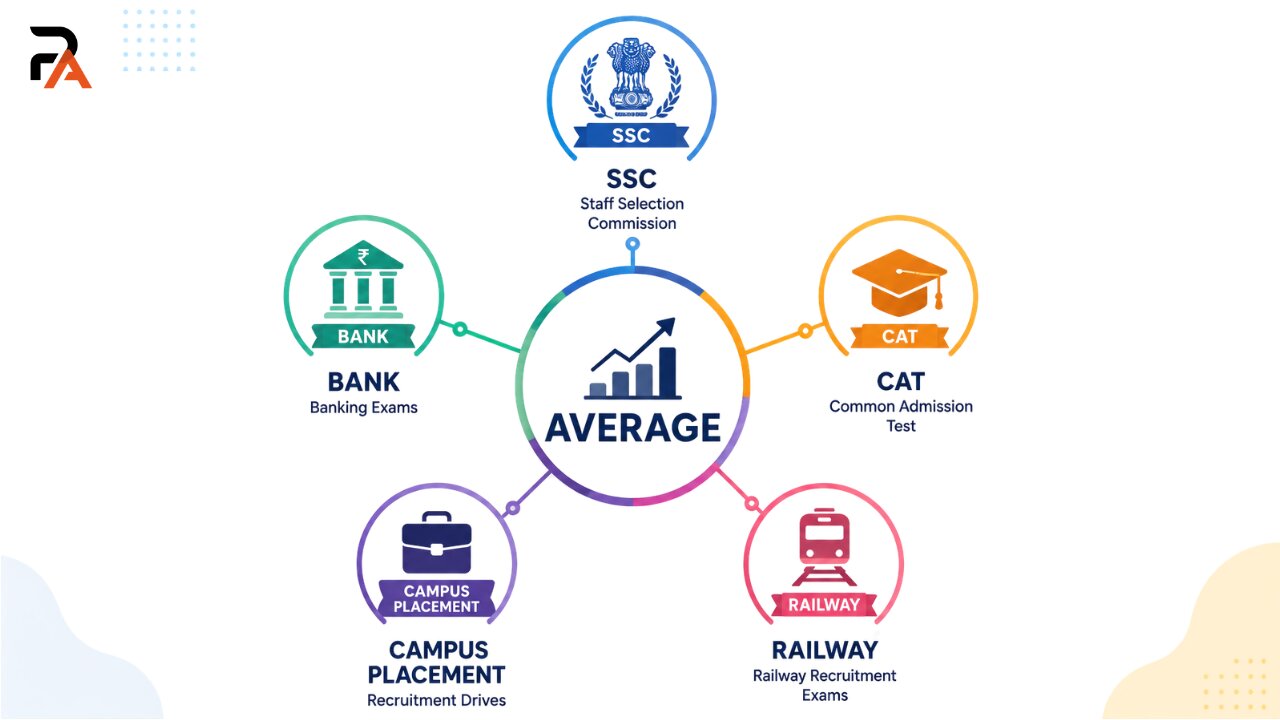
Average is one of the most frequently tested topics in aptitude examinations. Whether you are preparing for campus placements, banking exams, SSC, UPSC, CAT, railway recruitment, or other competitive exams, understanding the concept of Average is essential. Although the questions often look straightforward, they can become tricky when they involve missing values, replacement of numbers, weighted averages, or consecutive numbers.
In simple terms, an average represents a single value that summarizes a group of numbers. Instead of looking at every value individually, the average gives us one number that reflects the overall performance or central value of the entire set.
For example, if five students score 70, 75, 80, 85, and 90 marks, we don’t have to compare every score separately. By finding the average, we can quickly understand the group’s overall performance.
The Average topic is not only useful for aptitude tests but also for everyday situations such as calculating:
- Student marks
- Monthly expenses
- Salaries
- Cricket batting averages
- Team performance
- Business profits
- Customer ratings
In competitive exams, average questions usually require only basic arithmetic. However, solving them quickly depends on understanding the right formulas and shortcuts rather than performing lengthy calculations.
In this guide, you’ll learn the complete concept of averages, important formulas, common question types, and practical techniques that will help you solve questions accurately and within seconds.
Quick Answer
If you’re short on time, here’s everything you need to remember about Average.
Definition
Average is the value obtained by dividing the sum of all observations by the total number of observations.
Basic Formula
Average = Sum of Observations ÷ Number of ObservationsRemember These Three Facts
- Average tells the central value of a group.
- If the average and number of observations are known, the total sum can be found easily.
- Most aptitude questions are solved using only three formulas:
- Average = Sum ÷ Number
- Sum = Average × Number
- Number = Sum ÷ Average
Exam Tip: Most competitive exams ask 2–5 questions from Average either directly or combined with topics like Ratio & Proportion, Profit & Loss, Percentages, and Time & Work. Mastering this topic can help you score easy marks in very little time.
Try It Yourself: Average Visualizer
Drag the circles below to change the three values and watch the blocks redraw themselves. Notice how the Original amounts bars are all different heights, but the Equal shares bars always level out to the same height — that height is the average.
Original amounts
Equal shares
x̄ is the arithmetic mean (simple average)
Why Average Matters in Aptitude
Many students consider Average to be one of the easiest aptitude topics because the formula is simple. However, competitive exams rarely ask direct formula-based questions. Instead, they test how well you understand the concept behind the average.
For example, an exam may state that the average age of a group changes after one person joins or leaves. Instead of adding every age again, you must understand how the total sum changes. This conceptual approach allows you to solve questions much faster.
Average also forms the foundation for many other aptitude topics. Questions involving percentages, ratios, mixtures, profit calculations, and statistics often require average calculations. Therefore, mastering this topic improves your overall quantitative aptitude skills.
Exams Where Average Questions Commonly Appear
- Campus Placement Tests
- Bank PO & Clerk Exams
- SSC CGL & CHSL
- RRB Exams
- CAT & MBA Entrance Exams
- UPSC CSAT
- Insurance Exams
- State PSC Exams
Real-Life Applications
Average is used in many daily situations, including:
- Calculating class marks
- Finding average monthly income
- Measuring cricket batting averages
- Calculating average speed during travel
- Business sales analysis
- Weather reports
- Customer satisfaction ratings
- Employee performance evaluation
Because averages appear everywhere, learning this topic benefits both exam preparation and practical decision-making.
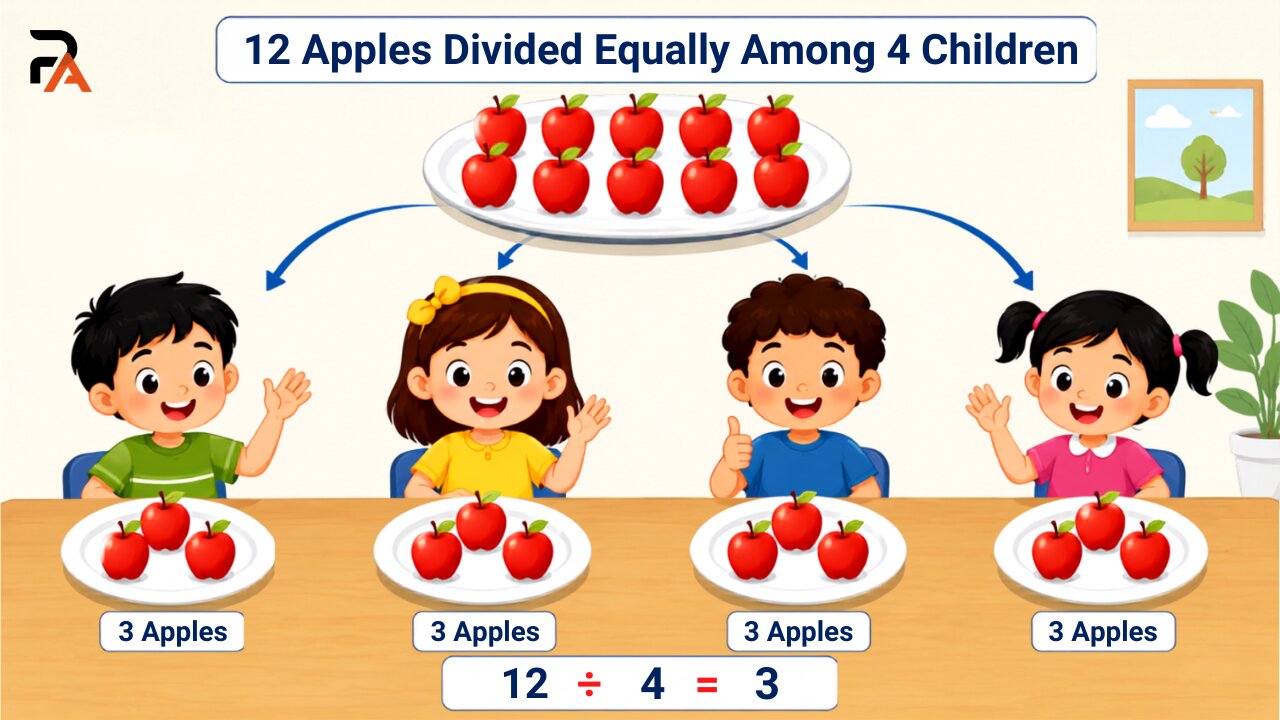
What is Average?
Average is a mathematical measure that represents the typical or central value of a group of numbers. It combines multiple values into one meaningful number, making comparisons much easier.
Instead of studying every observation individually, we use the average to understand the overall trend.
For example, suppose five students scored:
60, 70, 80, 90, 100Rather than analyzing each mark separately, we calculate the average.
Step 1: Find the Total Marks
60 + 70 + 80 + 90 + 100 = 400Step 2: Count the Number of Students
5Step 3: Calculate the Average
Average = 400 ÷ 5 = 80This means that the overall performance of the class is represented by 80 marks.
Understanding Average with Everyday Examples
Example 1: Monthly Spending
Suppose your expenses for five months are:
₹8,000, ₹9,000, ₹7,500, ₹8,500, ₹9,000Instead of remembering every month’s expense, you can calculate the average monthly spending.
This provides a quick summary of your spending habits and helps you estimate future expenses more accurately.
Example 2: Cricket
A batsman scores:
45, 62, 51, 78, 64Instead of discussing every innings separately, commentators often mention the player’s average score.
This gives a better picture of the player’s consistency across multiple matches.
Example 3: Classroom Marks
Suppose 40 students write an examination.
Instead of checking all 40 marks individually, teachers calculate the average marks to evaluate the overall performance of the class.
This helps identify whether the exam was easy, difficult, or of moderate difficulty.
Why Do We Use Average?
Average helps us:
- Simplify large sets of numerical data.
- Compare different groups easily.
- Measure overall performance.
- Estimate expected values.
- Make better financial and business decisions.
- Analyze trends over time.
- Summarize information using a single representative value.
Because of these advantages, averages are widely used in mathematics, statistics, economics, education, sports, finance, business, weather forecasting, healthcare, and scientific research.
Arithmetic Mean
When aptitude exams mention the word Average, they almost always refer to the Arithmetic Mean.
Arithmetic Mean is calculated by adding all observations together and dividing the total by the number of observations.
Arithmetic Mean = Sum of Observations ÷ Number of ObservationsFor example,
Numbers:
12, 18, 24, 30, 36Total
12 + 18 + 24 + 30 + 36 = 120Average
120 ÷ 5 = 24The Arithmetic Mean is the standard average used in almost every aptitude examination, including SSC, Banking, CAT, Railway, Campus Placements, and UPSC CSAT.
Average Formula & Rules
Understanding the formulas is the key to solving Average questions quickly in competitive exams. Fortunately, the Average chapter requires only a few important formulas. Once you understand these formulas and their applications, you can solve most aptitude questions within seconds.
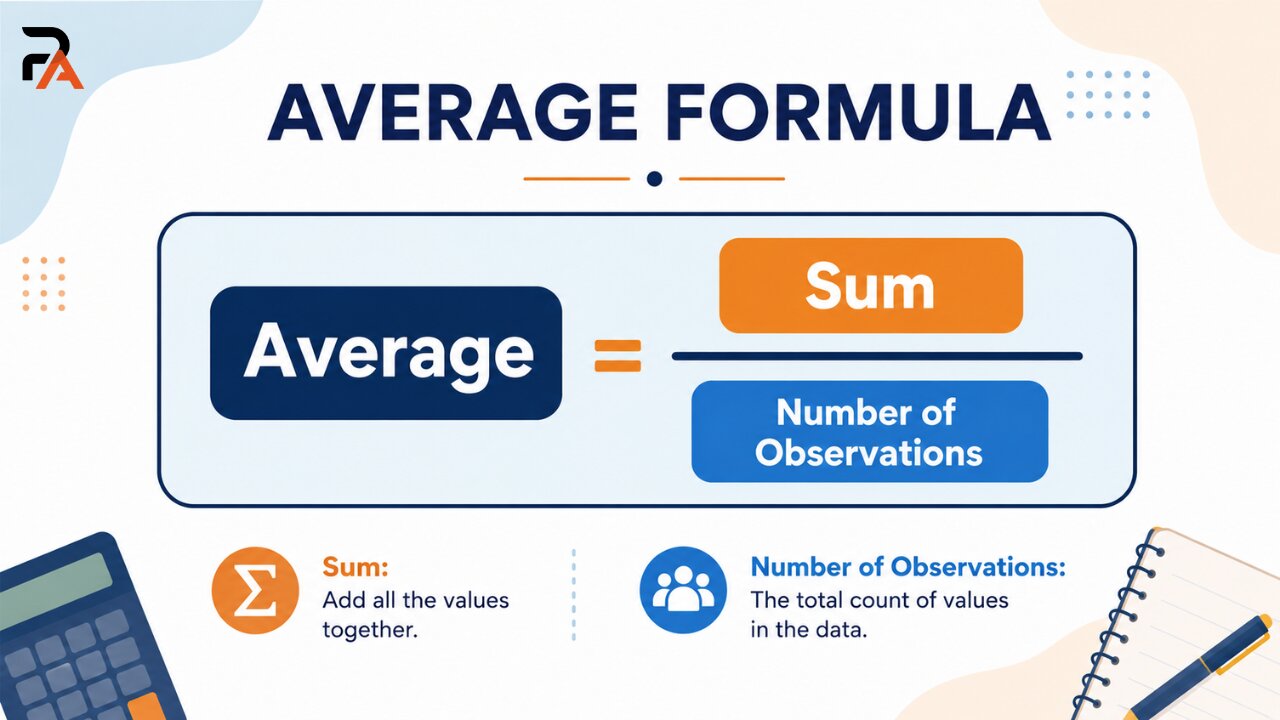
1. Basic Average Formula
The most important formula is:
Average = Sum of Observations ÷ Number of ObservationsExample
Numbers:
15, 20, 25Find the total:
15 + 20 + 25 = 60Average:
60 ÷ 3 = 20Answer: 20
2. Finding the Sum
If the average and number of observations are known:
Sum = Average × Number of ObservationsExample
Average marks = 72
Number of students = 25
Total Marks
= 72 × 25
= 1800
Answer: 1800
3. Finding the Number of Observations
If the total sum and average are known:
Number of Observations = Sum ÷ AverageExample
Total marks = 1080
Average = 60
Number of Students
= 1080 ÷ 60
= 18
Answer: 18
4. Average of Consecutive Numbers
For consecutive numbers, the average is simply the middle number.
Example 1
11, 12, 13, 14, 15Average = 13
Example 2
25, 26, 27, 28, 29Average = 27
This shortcut saves valuable time during aptitude exams because you don’t need to calculate the total.
5. Effect of Increasing or Decreasing Every Number
If every number increases by a certain value, the average also increases by the same value.
Similarly, if every number decreases by a fixed value, the average also decreases by that amount.
Example
Original numbers:
10, 20, 30Average:
20Add 5 to every number:
15, 25, 35New Average:
25Since each number increased by 5, the average also increased by 5.
6. Replacement Rule
When one value is replaced by another, use the following shortcut:
New Sum = Old Sum − Removed Value + Added ValueThen,
New Average = New Sum ÷ Number of ObservationsExample
The average age of 5 students is 20 years.
One student aged 18 leaves, and another aged 22 joins.
Original Sum:
20 × 5 = 100New Sum:
100 − 18 + 22 = 104New Average:
104 ÷ 5 = 20.8Answer: 20.8 years
This shortcut is frequently used in banking, SSC, and placement examinations.
Key Formula Summary
| Formula | Use |
|---|---|
| Average = Sum ÷ Number | Find the average |
| Sum = Average × Number | Find the total sum |
| Number = Sum ÷ Average | Find the number of observations |
| Average of Consecutive Numbers | Middle Number |
| Each value increases by x | Average also increases by x |
| Each value decreases by x | Average also decreases by x |
| Replacement Rule | New Sum = Old Sum − Removed Value + Added Value |
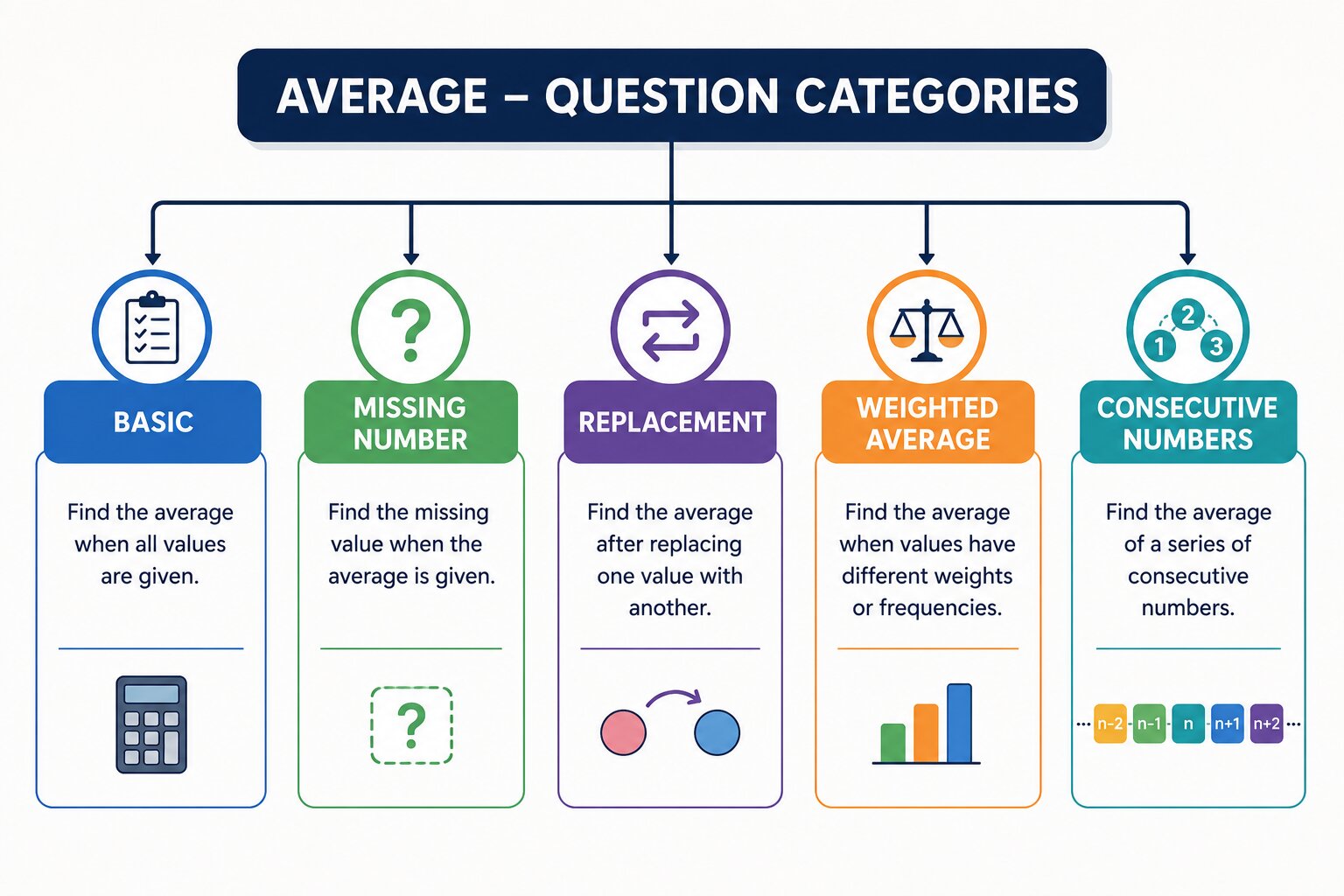
Types of Average Questions
Competitive exams do not ask the same type of average question repeatedly. Instead, they test your understanding by presenting averages in different situations. Recognizing these question patterns helps you choose the correct approach quickly and avoid unnecessary calculations.
Below are the most common types of Average questions asked in aptitude exams.
1. Basic Average Questions
These are the simplest questions where all numbers are provided.
You only need to:
- Find the total sum.
- Divide by the number of observations.
Example Pattern
Find the average of:
12, 18, 24, 30, 36These questions mainly test your calculation speed and accuracy.
Shortcut: Add all numbers carefully and divide only once.
2. Finding the Total Sum
Sometimes the average and number of observations are given, and you need to calculate the total.
Example Pattern
The average score of 25 students is 68.
Find the total marks scored.
Use:
Sum = Average × NumberThese questions are very common in Banking and Campus Placement examinations.
3. Finding the Missing Number
One number is missing while the average and remaining numbers are given.
Example Pattern
The average of five numbers is 30.
Four numbers are:
25, 28, 32, 35Find the fifth number.
Approach
- Find the total sum using the average.
- Add the known numbers.
- Subtract to obtain the missing value.
4. Average After Replacement
One member of the group is replaced by another.
Example Pattern
The average age of 10 students is 18 years.
One student aged 16 leaves, and another aged 20 joins.
Find the new average.
Instead of calculating everything again, simply adjust the total using the replacement rule.
5. Average After Addition or Removal
A new member joins a group or someone leaves.
These questions frequently appear in SSC, Banking, Railway, and Placement exams.
Example Pattern
The average salary of 12 employees is ₹35,000.
A new employee joins with a salary of ₹40,000.
Find the new average.
Always calculate the original total first before finding the updated average.
6. Average of Consecutive Numbers
These questions involve consecutive integers.
Example Pattern
Find the average of:
51, 52, 53, 54, 55Since the numbers are consecutive, the answer is simply:
53No lengthy calculations are required.
7. Average Speed Questions
These questions combine Average with Time, Speed, and Distance.
Example
A person travels at 40 km/h and returns at 60 km/h.
The average speed is not
(40 + 60) ÷ 2These questions use a special Average Speed formula, which is covered in the Time, Speed and Distance chapter.
8. Weighted Average Questions
Sometimes two or more groups have different numbers of people.
Example Pattern
The average marks of boys and girls are given separately.
Find the overall average.
These questions require a weighted average, not a direct average of the two averages.
9. Mixed Average Problems
Some questions combine Average with other aptitude topics such as:
- Percentage
- Ratio and Proportion
- Profit and Loss
- Ages
- Mixtures
- Statistics
These questions are commonly asked in CAT and higher-level competitive examinations.
Solved Examples
The following examples progress from easy to moderate difficulty and demonstrate the techniques commonly used in aptitude tests.
Example 1: Find the Average
Question
Find the average of:
15, 25, 35, 45, 55Solution
Step 1
Find the total.
15 + 25 + 35 + 45 + 55 = 175Step 2
There are 5 numbers.
Average = 175 ÷ 5 = 35Answer
35
Example 2: Average Marks
Question
The average marks of 8 students are 72.
Find the total marks.
Solution
Use:
Sum = Average × Number72 × 8 = 576Answer
576
Exam Tips
✔ Read the question carefully to identify which quantity is missing.
✔ If the average is given, first calculate the total sum.
✔ For consecutive numbers, never waste time adding all the numbers.
✔ Use the replacement rule whenever one value is replaced.
✔ Practice multiplication tables to improve calculation speed.
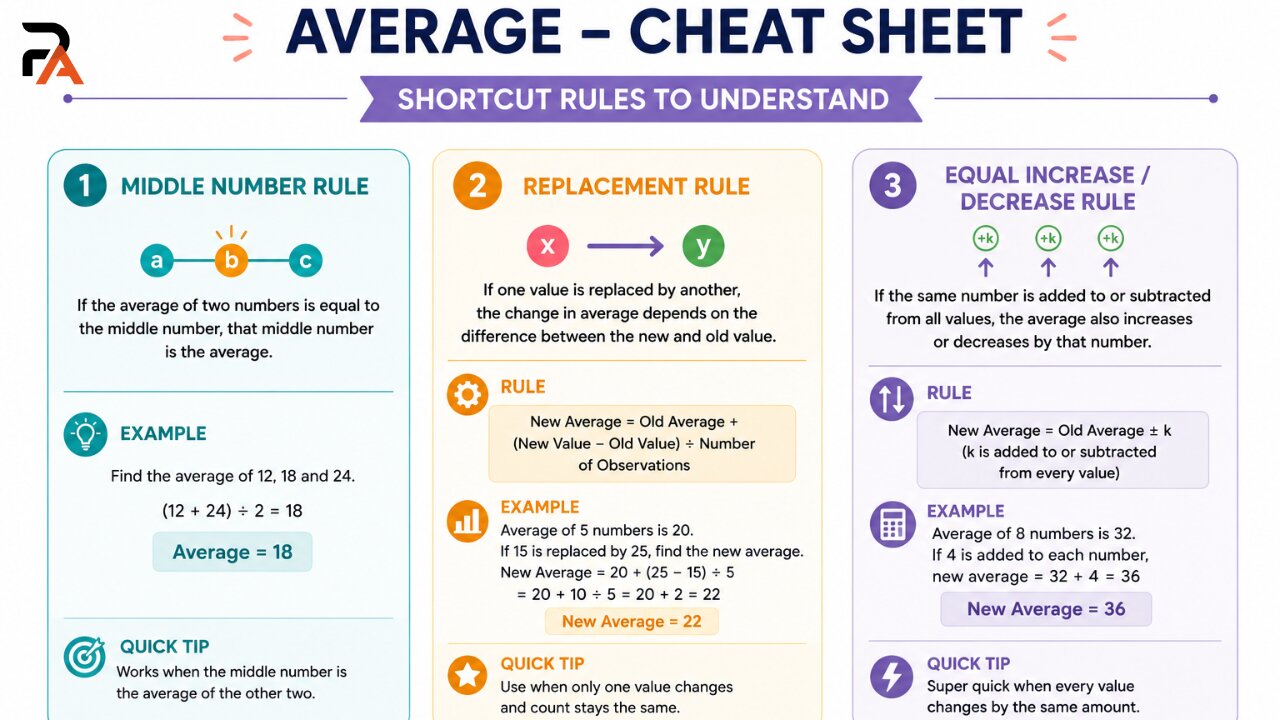
Shortcut Tricks to Solve Average Questions Faster
Competitive exams are all about speed and accuracy. Instead of performing lengthy calculations, use these simple tricks to solve Average questions quickly.
Trick 1: Consecutive Numbers
For consecutive numbers, the average is simply the middle number.
Example
41, 42, 43, 44, 45Average = 43
This shortcut works because the numbers are equally spaced around the middle value.
Trick 2: Equally Spaced Numbers
When numbers increase or decrease by the same amount, the average can be found using:
Average = (First Number + Last Number) ÷ 2Example
12, 16, 20, 24, 28Average = (12 + 28) ÷ 2
= 40 ÷ 2
= 20You don’t need to add every number individually.
Trick 3: Use Total Instead of Individual Values
Whenever the average and number of observations are given, first calculate the total sum.
This avoids repeated calculations and makes solving addition or removal questions much easier.
Example
Average = 45
Number of students = 20
Total = 45 × 20 = 900Now use the total for the remaining calculations.
Trick 4: Replacement Shortcut
Instead of recalculating the entire average:
New Sum = Old Sum − Removed Value + Added ValueThen,
New Average = New Sum ÷ Number of ObservationsThis shortcut is widely used in SSC, Banking, and Placement examinations.
Trick 5: Equal Increase or Decrease
If every number increases by the same value, the average also increases by that value.
Similarly, if every number decreases by a fixed amount, the average decreases by that amount.
Example
Original numbers:
15, 25, 35Average = 25
Add 10 to every number:
25, 35, 45New Average = 35
No lengthy calculations are required.
Trick 6: Learn Mental Multiplication
Most Average questions involve multiplication.
Learning multiplication tables up to 25 can significantly improve your solving speed.
For example,
24 × 25 = 600Knowing such values instantly saves valuable time during exams.
Common Mistakes to Avoid
Many students lose easy marks because of simple calculation mistakes or incorrect formulas.
Avoid these common errors.
Mistake 1: Dividing by the Wrong Number
Always divide by the correct number of observations.
Incorrect
Total = 240

Divide by 5 instead of 6
Correct
Average = 240 ÷ 6Mistake 2: Incorrect Addition
A small addition mistake changes the final answer completely.
Always double-check the total before dividing.
Mistake 3: Ignoring Group Size
When combining two groups, do not simply average their averages.
Incorrect
Average of Boys = 70

Average of Girls = 80

Overall Average = 75 ❌
If the number of boys and girls is different, this answer will be incorrect.
Always calculate the total marks first.
Mistake 4: Recalculating Everything
Many students calculate the entire sum again when only one value changes.
Instead, use the Replacement Rule.
Mistake 5: Confusing Formulas
Remember:
Average = Sum ÷ NumberDo not confuse Average formulas with Percentage, Ratio, or Profit & Loss formulas.
Practice Questions
Try solving these questions on your own before checking the answers.
Beginner Level
1.
Find the average of:
18, 24, 30, 36, 422.
The average of 8 numbers is 25.
Find their total.
3.
The average of five numbers is 32.
Four numbers are:
28, 30, 35, 36Find the fifth number.
4.
Find the average of:
81, 82, 83, 84, 855.
The average salary of 20 employees is ₹32,000.
Find the total salary.
Intermediate Level
6.
A student scored:
62, 68, 70, 75, 80Find the average.
7.
The average age of 12 people is 24 years.
One person aged 20 years leaves.
Find the new average.
8.
The average of six numbers is 40.
If one number is removed and the average becomes 38, find the removed number.
Advanced Level
9.
The average marks of boys is 72, and girls is 78.
If there are 20 boys and 15 girls, find the overall average.
10.
The average of the first 15 natural numbers is ______.
Answer Key
| Question | Answer |
|---|---|
| 1 | 30 |
| 2 | 200 |
| 3 | 31 |
| 4 | 83 |
| 5 | ₹640,000 |
| 6 | 71 |
| 7 | 24.36 years |
| 8 | 50 |
| 9 | 74.57 |
| 10 | 8 |
Frequently Asked Questions (FAQs)
1. What is the average in mathematics?
Average is the value obtained by dividing the sum of all observations by the total number of observations. It represents the central value of a group of numbers.
2. What is the basic formula for Average?
Average = Sum of Observations ÷ Number of ObservationsThis is the standard formula used in almost every aptitude question.
3. Which competitive exams include Average questions?
Average questions frequently appear in:
- Banking Exams
- SSC Exams
- CAT
- UPSC CSAT
- Railway Exams
- Insurance Exams
- Campus Placement Tests
- State PSC Exams
4. How can I solve Average questions faster?
You can improve your speed by:
- Learning the basic formulas.
- Using consecutive number shortcuts.
- Applying replacement rules.
- Practicing mental calculations.
- Solving previous years’ aptitude questions regularly.
5. Is Average an easy aptitude topic?
Yes.
Average is considered one of the easiest quantitative aptitude topics because it requires only basic arithmetic and logical thinking.
With regular practice, most Average questions can be solved within 30–60 seconds.
6. What are the most common mistakes in Average questions?
Common mistakes include:
- Incorrect addition of values.
- Dividing by the wrong number of observations.
- Forgetting to update the total after adding or removing a value.
- Averaging two group averages directly without considering group sizes.
Conclusion
Average is one of the most important and highest-scoring topics in quantitative aptitude. Although the formula is simple, competitive exams often test your conceptual understanding through practical scenarios involving missing values, replacements, group averages, and consecutive numbers.
By mastering the basic formulas, understanding shortcut techniques, and practicing a variety of question types, you can solve Average problems quickly and accurately.
To strengthen your aptitude preparation even further, continue learning related topics such as Percentage, Ratio and Proportion, Profit and Loss, Simple Interest, and Time, Speed and Distance. These concepts are frequently combined in competitive examinations, and a strong foundation in each topic will improve both your speed and confidence.
With consistent practice and regular revision, Average can become one of the easiest sections to score full marks in any aptitude exam.